

The culture of strengths connects our teams
The work environment is constantly changing. Technological progress, new forms of collaboration, and evolving employee needs demand adaptability, but also a clear focus. At GEN-I, we remain focused on people and their abilities. Our direction is clear: we are building an environment where individuals develop based on their strengths and talents, not their weaknesses.
We see strengths as a tool that contributes to better collaboration, more efficient work, and achieving business goals. When we know our own strengths and those of our colleagues, it becomes easier to form successful teams, make better decisions, and progress faster.
Five years of targeted development
From the very beginning, when this was still a pilot project, we have been developing the culture of strengths gradually and thoughtfully. We started by understanding the concept, continued with raising awareness and integrating it into everyday work, and today our goal is for strengths to become part of the language we use for faster mutual understanding, development planning, and task delegation.
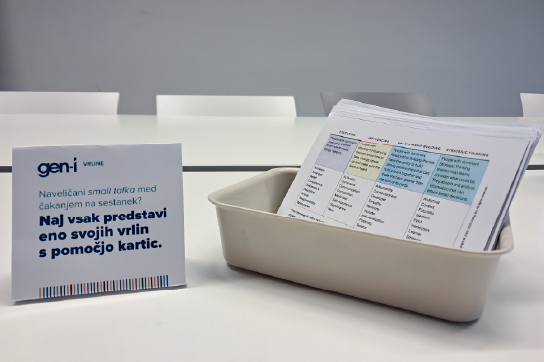
We want colleagues to know each other’s strengths and for this knowledge to influence how we collaborate. That is why we introduced a digital solution that enables voluntary sharing of strength reports with selected colleagues. Starting from the end of November, cards with information about individual strengths are also available in meeting rooms as a support for reflection, conversation, and teamwork.
Impact
Our data-driven approach allows us to evaluate initiatives like the culture of strengths based on actual results, not just impressions. For the culture of strengths, we are interested in how solutions are used and what impact they have. So far, 73% of employees have shared their report with someone in the organization, on average with as many as 23 colleagues. Leaders have been even more proactive than average as 88% have uploaded their report. In 87% of cases, sharing was mutual. This demonstrates a high level of trust and willingness for open communication.
These figures confirm that the culture of strengths is evolving not just as an idea but as a practice that employees embrace and use. In the coming months, we will further strengthen communication because we want strengths to remain an integral part of how we work.
Impact on collaboration
The culture of strengths is not a one-time initiative but a long-term process that we are developing with a clear goal: better collaboration and better results. When strengths become part of everyday conversations and decisions, the way we work together changes. Teams operate more harmoniously, communication becomes clearer, and relationships among colleagues more constructive.